The EAT project has developed and successfully implemented an elective course for first- and second-year medical students. Over the course of 28 teaching units (TU) spread over two weeks, students receive intensive training to prepare them for their future role as multipliers in patient consultations on climate-sensitive, health-promoting nutrition. The elective course was very well evaluated and significantly increased students' skills in climate-sensitive nutritional counseling. Knowledge about the climate impacts of human nutrition also increased significantly.
Asynchronous, learner-centered formats for self-study
- eLearning on the Planetary Health Diet,
- eLearning exercises on patient consultations,
- Educational videos: links to preclinical subjects (e.g., macro- and microanatomy), motivational interviewing, and climate-sensitive nutritional counseling,
- Exercises with ChatGPT on motivational interviewing.


Final examination
On the last day of the elective block, a combined knowledge and skills exam will be conducted in person with simulated patients.
We will provide you with the module handbook for the EAT elective upon request. Please feel free to contact us here.


The innovative EAT curriculum is suitable for all degree programs that include content related to communicating with patients about health, nutrition, and climate protection, for example:
- Health management
- Health sciences
- Public health
- Midwifery sciences
- Nursing sciences
- Nutrition sciences
- Dietetics
- Dentistry
- Home economics
| Methodology | |
|---|---|
| Satisfaction | |
| Knowledge growth | |
| Skills | |
| Settings | |
| Behavior | |
| Statistical analysis |
So far, two rotations in the summer semesters of 2024 and 2025 have been implemented with second-semester students and have been very well evaluated.
Successes of the implementation phase:
The EAT elective was successfully implemented in August 2025 with 25 students and 10 family doctor practices. Overall satisfaction with the elective was very high among students (92%). The work shadowing placements in family doctor practices, the units on motivational interviewing, and the joint cooking sessions were rated particularly positively.
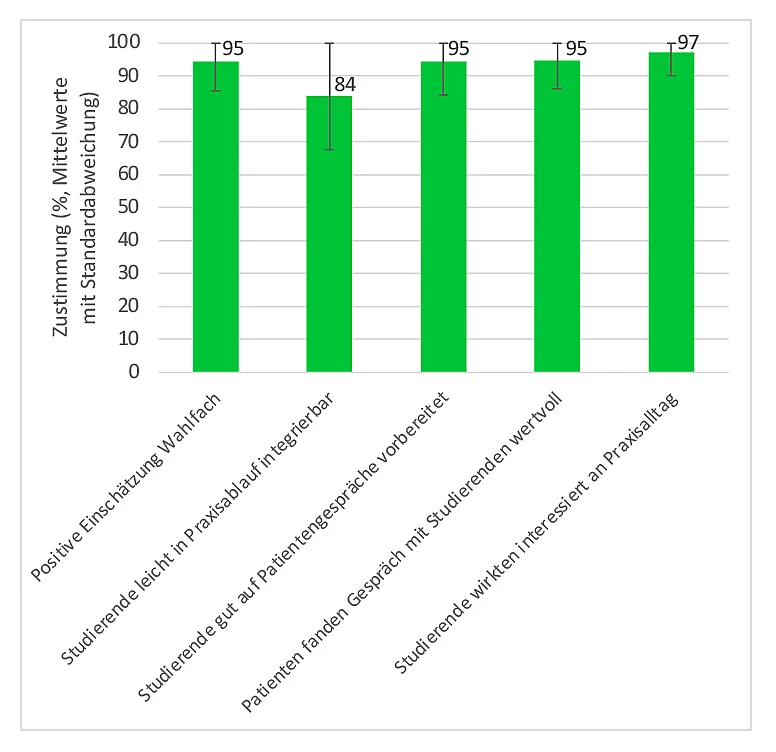
The family doctors also rated the elective course very positively, with a score of 95%. In their opinion, the students were very well prepared for the patient consultations on climate-sensitive nutrition and seemed interested in their everyday practice. Furthermore, the family doctors had the impression that their patients found the consultations with the students valuable (see Fig. 1).
Significant increases in competence were observed among students after participating in the elective course. Confidence in discussing sustainable nutrition with patients rose from 54% to 79% (p = 0.005). Knowledge of the climate impact of nutrition also improved significantly, from 49% to 77% (p = 0.014).
The family doctors already had a high level of expertise and felt confident talking to their patients about their diet. While the family doctors stated that they had rarely discussed the climate impact of their patients' diets in the past (41 ± 25%), after participating in the elective course, they planned to do so much more frequently in the future (84 ± 16%).
The elective course EAT thus effectively addresses students and family doctors' practices as (future) multipliers for sustainable nutrition.